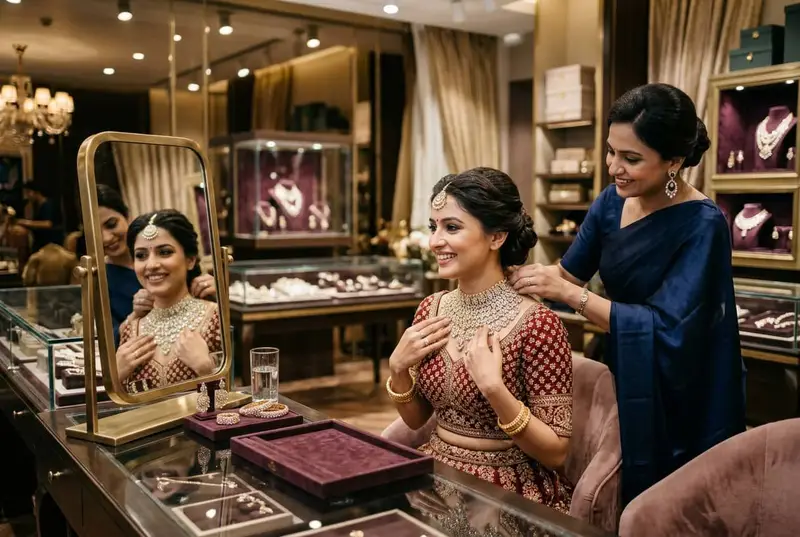
Buy the jewellery you will wear again - usually earrings, a versatile necklace and bangles - and consider renting the heavy, single-use bridal set. If you are buying gold, check for the BIS hallmark and its six-digit HUID, which is the official mark of assayed purity in India. Choose the pieces after the outfit, so necklines and embroidery weight decide the scale.
Key Takeaways
- Decide piece by piece: some items are worth owning, others are worn once.
- For gold, the BIS hallmark is the verifiable indicator of purity.
- Polki uses uncut diamonds; kundan is a setting technique, often with glass or stones - the words are not interchangeable.
- Heavier embroidery generally calls for fewer, larger jewellery pieces.
- Rental terms vary widely; read the damage and deposit clauses before signing.
Should You Buy or Rent Bridal Jewellery?
| Piece | Usually worth buying | Usually worth renting |
|---|---|---|
| Everyday-wearable earrings | Yes | - |
| Mid-weight necklace you can restyle | Yes | - |
| Very heavy bridal choker or rani haar | Only if it is a family piece | Often |
| Maang tikka, haath phool, matha patti | Sometimes | Often |
| Statement pieces for one function only | - | Yes |
Sentiment matters as much as arithmetic here. Many families pass down a ceremony set, and in that case the shopping question becomes what to add around it rather than what to buy outright.
How Do You Check Gold Jewellery Is Genuine?
In India, hallmarking of gold jewellery is administered by the Bureau of Indian Standards. Hallmarked pieces carry the BIS mark, the purity or fineness mark, and a six-digit alphanumeric HUID, which can be verified through BIS's own channels. Ask for a bill that states purity, net weight and making charges separately - weight and charges, not just the headline price, are what differ between sellers. You can read the official position on hallmarking on the BIS website *(objective fact - sourced)*.
For silver and imitation jewellery, hallmarking is handled differently, so treat a seller's own certificate as a description rather than as independent assay.
Polki, Kundan, Temple and Meenakari
- Polki: uncut, unfaceted natural diamonds set in gold. Typically the most expensive of the traditional styles.
- Kundan: a setting technique where stones are held by fine gold foil; the stones may be glass, semi-precious or precious, so price varies enormously.
- Temple jewellery: South Indian style with deity and motif work, traditionally paired with silk sarees.
- Meenakari: enamel work, often on the reverse of kundan pieces, giving a coloured finish suited to lighter outfits.
Knowing which of these you are actually being offered is the single most useful thing to establish before discussing price.
Matching Jewellery to the Outfit
Choose jewellery after the outfit is finalised. A densely embroidered lehenga usually reads better with one or two substantial pieces than with a full layered set, while a plainer silk saree can carry a heavier necklace and more layering. Necklines decide length: a high or closed neckline generally suits a longer haar, while a wide or deep neckline suits a choker sitting above it.
Our guide on bridal jewellery combinations for your lehenga works through this by colour family, and the bridal accessory guide covers the pieces beyond the main set.
Practical Points Before You Pay
- Ask what the piece weighs - heavy chokers and tikkas are often uncomfortable over a long ceremony.
- Try the set with the actual blouse and hairstyle, not with everyday clothes.
- For rentals, note the pickup and return dates against your function schedule, and photograph the pieces at handover.
- Confirm buy-back or exchange terms in writing if you are buying gold as part of a longer-term plan.
- Keep the ceremony set and the reception set separate in packing, labelled by function.
Our wedding shopping assistance team handles jewellery selection alongside the outfits so the scale and neckline decisions are made together rather than in separate shops.
Planning your bridal jewellery around the outfits? Get My Wedding Shopping Plan and we'll work through it with you.