Coordinating couple outfits well means the bride and groom read as a pair in photographs without wearing identical colours. The most reliable approach is choosing shades from the same family or bridging them through an accent colour, embroidery style or fabric weight, then repeating that logic across every wedding function from haldi to reception.
Key Takeaways
- Identical colours rarely photograph as well as same-family shades or complementary contrasts.
- Plan the main ceremony coordination first, since the bride's outfit is usually finalised before the groom's.
- Match embroidery density and fabric weight, not just colour, so neither outfit looks under- or over-dressed next to the other.
- Use an accent colour bridge - a dupatta border, pocket square or buttons - when the two outfits are in entirely different palettes.
- Share your finalised palette with the photographer so lighting and backdrops can be planned around it.
The Golden Rule: Complement, Don't Match
The most common mistake couples make is buying near-identical colours - a groom in the exact red of the bride's lehenga looks like a uniform rather than a couple. Instead, aim for complementary coordination:
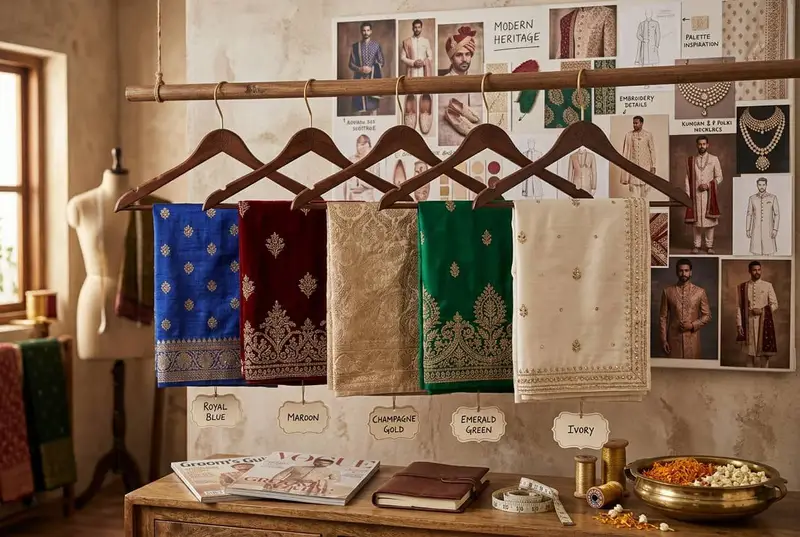
- Same colour family, different shades: bride in deep maroon, groom in wine or burgundy
- Accent matching: the groom's pocket square or stole picks up the bride's dupatta colour
- Metal consistency: if the bride wears gold jewellery, the groom's buttons or embroidery should also be gold-toned, not silver
Placing your outfit swatches side by side in natural daylight before finalising anything is a simple habit that catches undertone clashes a screen or a shop's artificial lighting can hide.
Colour Coordination Strategies
Same Family, Different Shades
- Bride in red → groom in maroon or wine
- Bride in pink → groom in dusty rose or mauve
- Bride in gold → groom in champagne or ivory
Complementary Contrasts
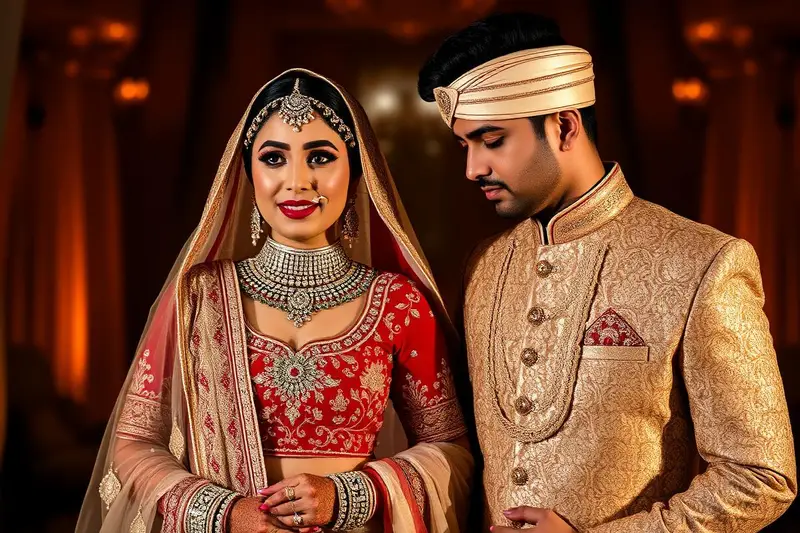
- Bride in red → groom in ivory or cream (the classic pairing)
- Bride in pink → groom in sage green or teal
- Bride in turquoise → groom in coral or gold
Accent Colour Bridge
The bride and groom wear different primary colours but share an accent through embroidery, dupatta or accessories - for example, a maroon lehenga with gold embroidery paired with an ivory sherwani that carries the same gold thread work. This is often the most sophisticated of the three approaches, since it lets each outfit stand on its own while still visually linking the two.
Colour Coordination by Function
Wedding Ceremony
- Classic: bride in red lehenga, groom in cream or ivory sherwani with red accents
- Modern: bride in blush pink, groom in slate grey with a pink pocket square
- South Indian: bride in a red Kanjeevaram, groom in a cream veshti with a matching silk angavastram
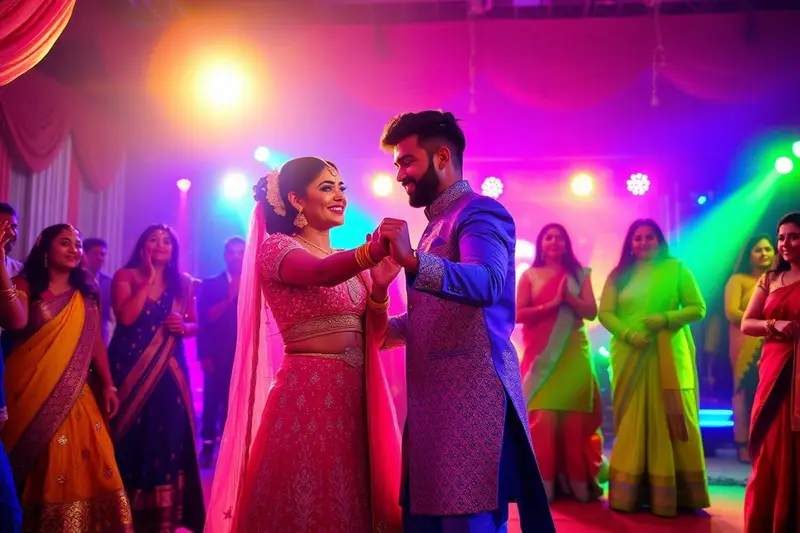
Sangeet Night
- Metallic tones: bride in a gold sequin lehenga, groom in midnight navy with gold buttons
- Bold option: bride in electric blue, groom in black with blue cufflinks or a brooch
- Printed pairing: both in coordinating patterns rather than solid colours
Mehendi Ceremony
- Fresh palette: yellow, green and coral work well for both
- Bride in a floral-print lehenga or sharara in sunshine yellow
- Groom in white with yellow embroidery, or a green Nehru jacket over white
Reception
- Glamorous: bride in a pastel gown or saree, groom in a tailored tuxedo or bandhgala
- Understated luxury: both in a monochrome palette - ivory, champagne or sage
Fabric, Texture and Embroidery Coordination
Beyond colour, coordinate these elements so the two outfits feel like they belong to the same wedding:
- Embroidery style: if the bride's lehenga has zardozi work, echo similar metalwork on the groom's sherwani collar rather than plain thread embroidery
- Fabric weight: both outfits should feel equally luxurious - pairing heavy velvet with lightweight cotton reads as mismatched
- Embellishment density: a heavily embroidered bridal lehenga next to a completely plain groom's kurta looks unbalanced; the groom's outfit should carry proportionate, though not equal, detail
- Era consistency: avoid mixing an ultra-modern groom look with a very traditional bridal one unless that contrast is the intended fusion aesthetic
How to Shop Together
- Start with the bride's outfit - in many weddings the bridal look is chosen first, and the groom's outfit is built to complement it
- Carry swatches - bring a fabric swatch or photo of the bridal outfit when shopping for the groom
- Use a stylist - wedding shopping assistance can coordinate both outfits across multiple shopping trips and cities
- Factor in the venue - an outdoor garden wedding calls for a different coordination approach than a grand ballroom
- Think about the photographs - how the outfits will look standing, sitting and walking together matters as much as how each looks alone
When Styles Genuinely Differ
Not every couple wants the same aesthetic, and that's fine - a bride who loves heavy traditional embroidery and a groom who prefers minimal, structured silhouettes can still coordinate through colour and formality level alone, without forcing matching embellishment. The key is agreeing on one or two shared anchors (usually colour and fabric weight) and letting everything else - cut, embroidery density, accessories - reflect each person's own taste. This tends to photograph better than two people trying to force a single aesthetic that doesn't suit either of them.
Common Coordination Mistakes
| Mistake | Why It Doesn't Work | Better Approach |
|---|---|---|
| Identical colours | Reads as costume, not coordination | Same family, different depth |
| Ignoring undertones | Warm red bride vs cool-toned blue groom clashes | Compare swatches in daylight together |
| Groom shopping last-minute | Outfit chosen without reference to the bride's look | Shop with both outfits in mind from the start |
| Mismatched metallics | Gold vs silver is the most common coordination error | Keep jewellery and embroidery in one metal family |
| Forgetting the photographer | Lighting and backdrop plans miss the palette | Share your finalised colours ahead of the shoot |
Accessorising the Coordinated Look
Footwear, jewellery and the smaller details finish off a coordinated couple look as much as the main outfit does. A groom's mojris or formal shoes should sit in the same tone family as his outfit rather than clashing with it, and a bride's footwear, while mostly hidden under a lehenga, still matters for reception looks where hemlines are shorter. Turbans, stoles and dupattas are also part of the coordination equation - a safa that ignores the bride's dupatta colour entirely can undo an otherwise well-planned palette. Treat these as part of the same shopping conversation rather than an afterthought picked up in the final week.
Regional Coordination Notes
In many Hindu weddings, red-and-gold remains the anchor palette for the ceremony, while South Indian coordination often runs through the veshti-saree border colour, with gold as the unifying thread across both outfits. In many Sikh weddings the groom's turban colour is a key coordination point with the bride's dupatta, and Muslim wedding wardrobes tend to offer more flexibility, with the groom's stole often carrying the coordinating accent.
Coordinating both outfits well takes more back-and-forth than most couples expect, and our bridal styling and groom styling teams work on both wardrobes together rather than in isolation. Get in touch to plan your palette function by function. For the main ceremony specifically, see wedding ceremony outfits for bride and groom.
For the individual looks behind the coordination, see our bridal accessory checklist and the groom sherwani guide.
The same thinking applies to the engagement ceremony and to your pre-wedding shoot.