Coordinating family outfits for an Indian wedding means building a shared colour palette wide enough for fifteen or twenty people of different ages and styles, then sequencing who shops when so the whole group photographs as a cohesive unit. This guide covers the outfit hierarchy by function, a practical shopping-trip plan for large families, and how to handle multi-city or mixed-tradition households.
Key Takeaways
- Build a palette of 3-4 complementary shades rather than one colour everyone must match exactly.
- Anchor the palette with the couple's own colours, then let parents and siblings coordinate outward from there.
- Sequence shopping trips by closeness and by function, not by trying to finalise everyone's outfit in one go.
- Use physical fabric swatches, not colour names or screenshots, when coordinating across a large or multi-city family.
- Keep 1-2 flexible neutral shades in reserve for guests confirmed late.
Why Family Outfit Coordination Matters
Group photographs, wedding albums and the shared social media moments from a wedding all look noticeably better when the family is colour-coordinated rather than a random mix. Beyond the visual impact, coordinated outfits are also a small but genuine way of showing thoughtfulness towards family members who are part of every ritual and portrait alongside the couple.
Build a Palette, Not a Single Colour
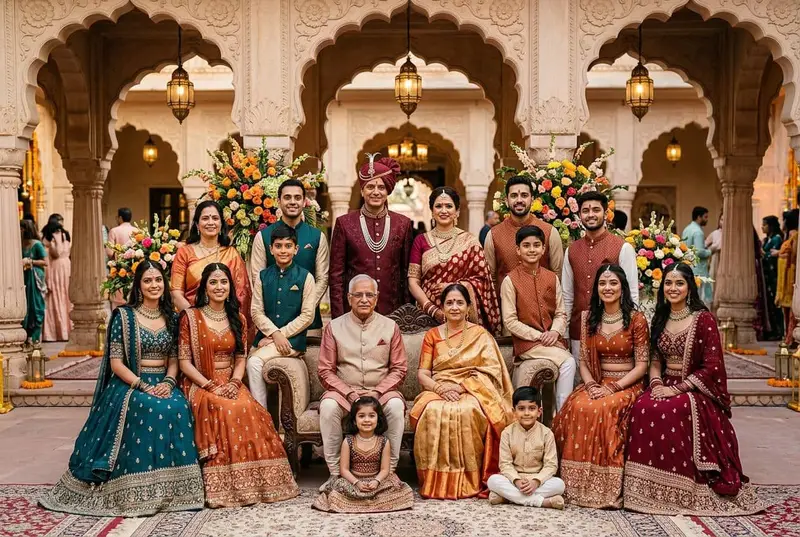
Instead of asking everyone to match one shade, choose a palette of three to four complementary colours - say, maroon, gold, blush and deep green - and let each person pick whichever shade suits their own skin tone. This avoids the two most common failure points: everyone in an identical colour looking flat in photos, or everyone choosing wildly different colours that clash against each other.
Share the palette as physical fabric swatches rather than colour names sent over WhatsApp - "maroon" means something different to every person's screen and imagination, and a swatch removes that ambiguity entirely.
The Family Outfit Hierarchy
Tier 1: Bride & Groom
Their outfits are chosen first, and everyone else coordinates around them.
Tier 2: Parents
Parents of both sides should be equally well-dressed, complementary to the couple rather than matching, and comfortable enough to get through a long day of rituals.
Tier 3: Siblings
Siblings extend the parents' palette into a slightly lighter register, with room for more embellishment, and should be dressed appropriately for their age and any ceremony-specific duties.
Tier 4: Extended Family
Grandparents, uncles, aunts and cousins need only a general colour guideline rather than strict coordination - comfort should take priority, especially for elderly members.
Sequence the Conversation by Closeness, Not Age
Start the coordination conversation with whoever will be in the most photographs - parents and siblings of the couple - before opening it up to extended family and in-laws. The core family's colours anchor the palette, and everyone else coordinates around that anchor rather than the reverse. Trying to gather opinions from thirty people before settling on a base palette usually stalls the entire process.
Avoid Matching Twins - Vary the Shade, Not the Palette
Buying the exact same fabric for the mother and mother-in-law, or for sisters standing together in photos, reads as costume rather than coordination. Keep everyone within the agreed palette but vary the exact shade, pattern and embellishment level by individual.
| Family Member | Role in Palette | Practical Note |
|---|---|---|
| Parents of bride/groom | Anchor the palette | Choose deeper, richer shades |
| Siblings | Complement, slightly lighter | Room for more embellishment |
| In-laws (different tradition) | Bridge with neutral shades | Respect their customary colours too |
| Extended family/guests | Loosely coordinate | Avoid exact colour matches with core family |
Solving the "Different Traditions" Problem
Many weddings today bring together families from different regional or religious backgrounds - a Hindu family used to a red-and-gold pairing alongside a Sikh or Muslim family with different traditional preferences. The fix isn't forcing one family's palette onto both sides; it's choosing 2-3 neutral bridging shades - gold, ivory, deep blue - that both families' traditional colours pair naturally with.
Function-Wise Family Outfit Guide
Haldi Ceremony
Yellow, orange, white and lime green in casual, stain-friendly fabrics. Parents in simple cotton kurta-pajama or saree, siblings in coordinated yellows or whites.
Mehendi Function
Green, pink, yellow and turquoise in semi-formal, festive pieces - embroidered kurtas or sarees in jewel tones for parents, matching or gradient colours for siblings.
Sangeet Night
Bold jewel tones and metallics, semi-formal to formal, with siblings often coordinated as a group if performing together.
Wedding Ceremony
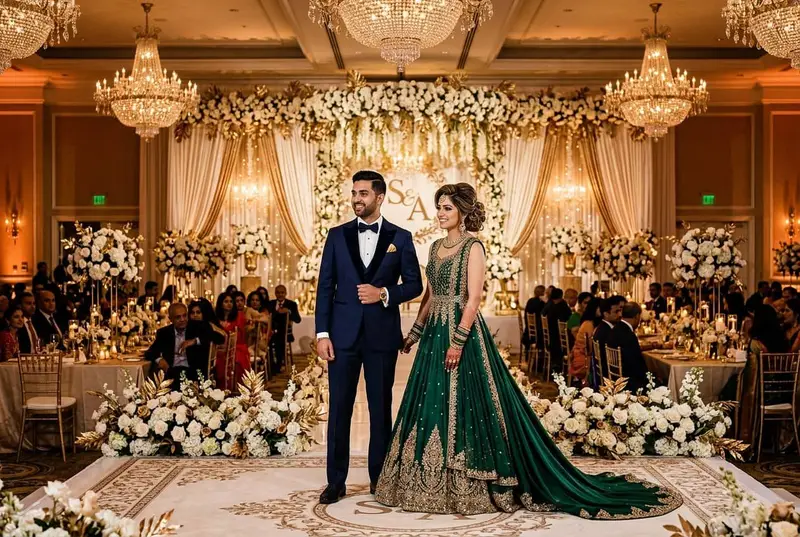
The palette should harmonise with the bride's lehenga - parents in their most formal pieces (silk saree, sherwani or bandhgala), siblings colour-coordinated with parents.
Reception
Elegant, evening-appropriate tones - designer wear and finer jewellery for parents, fashion-forward coordinated looks for siblings.
Mother and Father of the Bride/Groom
Mothers typically choose between a Kanjeevaram or Banarasi silk saree for the ceremony, a designer saree for the reception, and a sharara set or Anarkali for mehendi/sangeet - complementing the bride's palette in a different shade rather than competing with it, with well-tailored blouses making a noticeable difference. Fathers generally work with a sherwani or bandhgala for the ceremony, a kurta-pajama with a Nehru jacket for mehendi and sangeet, and a Western suit for a modern reception, with a safa or pagdi, pocket square and comfortable formal shoes rounding out the look. Our mother of the bride styling guide covers this in more depth.
Sibling Styling
Sisters often coordinate in a specific colour palette and may wear matching or near-matching lehengas for key ceremonies, while one sister may take on a slightly distinct outfit if she has bridesmaid-style duties. Brothers typically wear a bandhgala or kurta-pajama coordinated with the family palette, with comfortable footwear for baraat and long ceremonies. For young children, mini versions of the adult outfits work well, provided comfort comes first - cotton fabrics, easy closures, and a backup outfit on hand.
Family Wedding Shopping: Sequencing the Trips
Shopping for a large family is a logistics exercise as much as a styling one. A structured sequence works far better than everyone shopping independently and comparing notes afterwards.
1. Centralise the Decision-Making
Assign one coordinator - or work with a family wedding styling service - to hold the single source of truth on who has confirmed their outfit, who still needs a swatch, and whether the palette is holding together as pieces get finalised over several weeks.
2. Group Shopping Trips by Closeness, Then by Function
Shop for three to four family members at a time rather than everyone separately - it makes in-person colour comparison possible and prevents duplicated or clashing choices. Visiting markets with breadth across price points in a single trip is more efficient than multiple single-item visits.
3. Plan Function-Wise, Not Person-Wise
A typical wedding family needs outfits across mehendi/haldi, sangeet, the wedding ceremony and the reception - four outfits per person is common, so for a family of ten that's around forty outfits to track. Planning shopping trips around a function (all the sangeet outfits in one trip) rather than one person's entire wardrobe at once tends to keep the palette more consistent across the group.
4. Managing Coordination Across Multiple Cities
For families spread across cities - common with NRI weddings or simply large extended families - physically sharing swatches becomes harder. Assign one point of contact per branch of the family (an aunt on the groom's side, a cousin on the bride's side) who confirms choices back to the central planner, rather than expecting everyone to communicate directly with the couple, which tends to produce duplicated colours or missed people. Our online wedding stylist service supports exactly this kind of remote coordination.
5. Leave Room for Late Additions
Family palettes inevitably need to stretch for people confirmed late - a cousin flying in unexpectedly, or an in-law's relative added closer to the date. Keeping one or two flexible neutral shades within the original palette means a late addition can be slotted in without reopening the colour conversation with everyone who has already finalised their outfit.
Budget Planning for Family Outfits
| Family Member | Typical Number of Outfits |
|---|---|
| Mother of Bride/Groom | 4-5 |
| Father of Bride/Groom | 3-4 |
| Siblings (each) | 3-4 |
| Extended family | 1-2 |
Common Family Styling Mistakes
- No coordination at all - random colours create visual chaos in photographs
- Too much matching - looking like a uniform rather than a coordinated family
- Ignoring comfort - elderly family members left in heavy or restrictive outfits
- Last-minute shopping - no time left for alterations or genuine coordination
- Shopping individually without a shared reference, leading to clashing colours on the day
Coordinating a large family's wardrobe across cities, traditions and budgets is genuinely a full logistics job. Our family wedding styling service and wedding shopping assistance can hold that single source of truth for you. Get in touch to start building your family's palette.
For the shopping side of a multi-outfit wardrobe, see our city-by-city guide to wedding shopping markets in India.
Function-specific guidance helps here too: see our haldi outfit guide and South Indian wedding outfit guide.