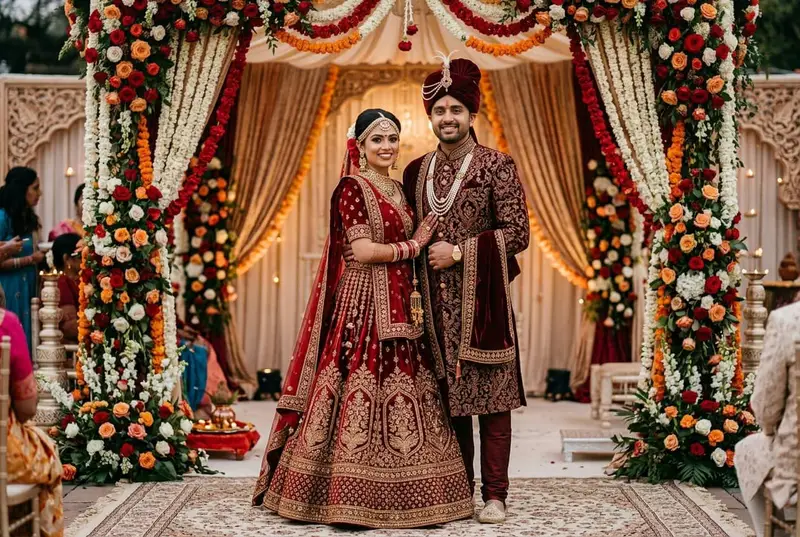
The most photographed moment of any Indian wedding is when the bride and groom stand together. When their outfits tell a cohesive visual story - without being identically dressed - the result is pure magic.
Our family styling service specializes in couple outfit coordination. Here's everything you need to know.
The Golden Rule: Complement, Don't Match
Let's start with the most important principle: never wear the same color. A groom in red standing next to a bride in red looks like a uniform, not a couple. The goal is harmony - colors, textures, and embroidery that belong in the same visual family without being identical.
Color Coordination Strategies
Strategy 1: Same Family, Different Shades
Choose colors from the same family but at different depths.
- Bride in red → Groom in maroon or wine
- Bride in pink → Groom in dusty rose or mauve
- Bride in gold → Groom in champagne or ivory
Strategy 2: Complementary Contrasts
Choose colors that are visually opposite but aesthetically connected.
- Bride in red → Groom in ivory or cream (the timeless classic)
- Bride in pink → Groom in sage green or teal
- Bride in turquoise → Groom in coral or gold
Strategy 3: Accent Color Bridge
The bride and groom wear different primary colors but share an accent color through embroidery, dupatta, or accessories.
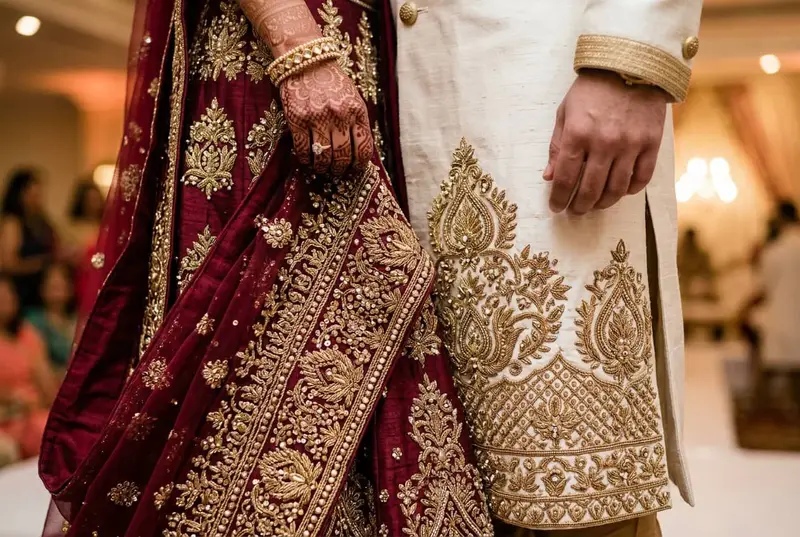
- Bride in maroon lehenga with gold embroidery → Groom in ivory sherwani with gold embroidery
- Bride in teal saree with copper zari → Groom in navy bandhgala with copper buttons
This is the most sophisticated approach and our most recommended strategy at StyleBuddy Weddings.
Function-by-Function Coordination
Haldi
- Keep it simple - both wear whites and yellows in different shades
- The groom can wear white with yellow accents; the bride can wear yellow with white accents
- Coordination should feel effortless, not forced
Mehendi
- This is the most flexible function. Coordinate through one shared accent color
- Example: Both incorporate teal or coral as a secondary color in their outfits
- Read our mehendi outfit guide for groom-specific ideas
Sangeet
- The sangeet is where couples often go bolder with coordination
- Consider matching metallics - both outfits feature gold or silver accents
- Or coordinate through formality level - both equally dressy, creating a power-couple visual
Main Ceremony
- The most important coordination point. Plan this first, then build other functions around it
- The bride's outfit typically comes first - the groom's sherwani is then designed to complement
- Embroidery style should be related - if the bride has zardozi, the groom should have zardozi too, not thread work
Reception
- Western-influenced coordination - the couple should look like they belong on the same red carpet
- If the bride wears a gown, the groom should be in a suit or tuxedo (not a sherwani)
- See our reception outfit guide for grooms for specific styles
Embroidery & Detailing Coordination
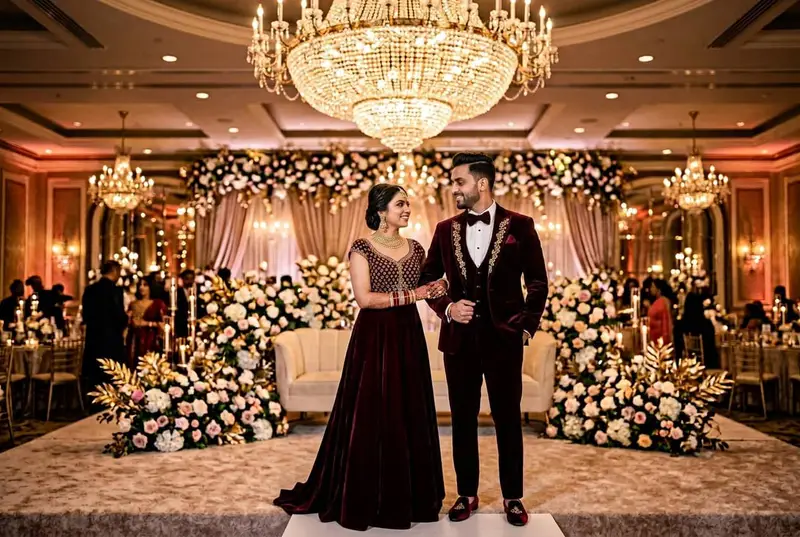
Beyond color, the texture and craft of your outfits should speak the same language.
Tips
- Match the metalwork: If the bride's lehenga has gold embroidery, the groom's sherwani should feature gold too - not silver
- Match the embroidery density: A heavily embroidered bridal lehenga paired with a plain groom kurta looks mismatched. The groom's outfit should have proportionate (though not equal) embellishment
- Coordinate the dupatta/stole: The groom's dupatta or stole can feature the same border pattern as the bride's dupatta
Fabric Coordination
- If the bride wears velvet, the groom should wear a fabric of equal weight - velvet, heavy silk, or brocade
- If the bride wears light georgette or organza, the groom should opt for lighter silks or cotton silk
- Mismatched fabric weight makes the couple look like they're from different weddings
How to Shop Together
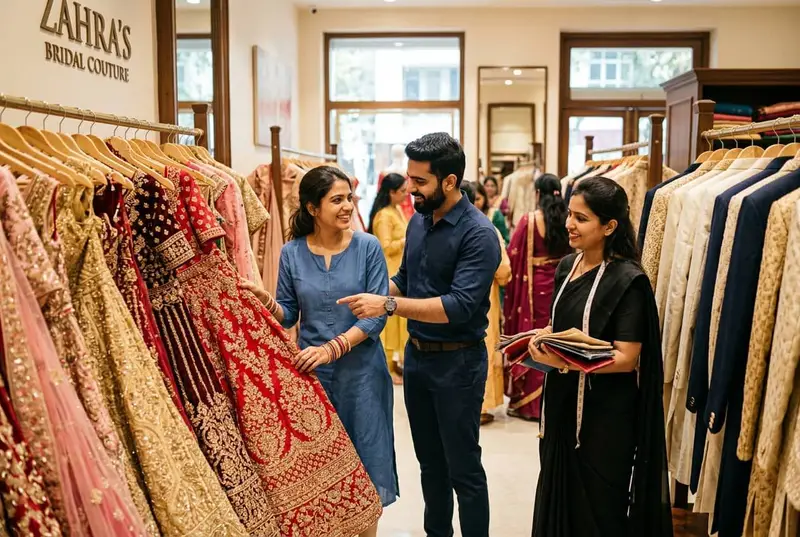
- Start with the bride's outfit: In Indian weddings, the bridal outfit is typically chosen first
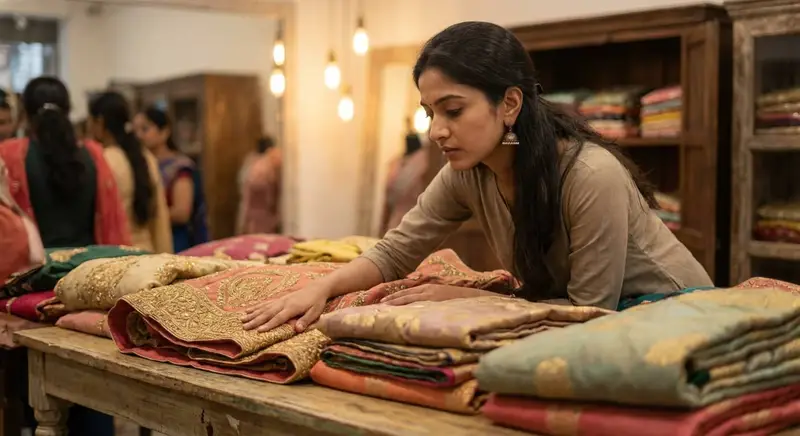
- Bring swatches: When shopping for the groom's outfit, carry a fabric swatch or photo of the bridal outfit
- Use a stylist: Our wedding shopping assistance service coordinates both outfits across multiple shopping trips
- Consider the venue: Outdoor garden weddings vs grand ballrooms call for different coordination approaches
- Think about photos: How will you look standing together? Sitting together? Walking together?
Common Coordination Mistakes
- Too matchy: Identical colors and patterns look like costumes, not coordination
- Ignoring metallics: Gold vs silver mismatch is the most common coordination error
- Different formality levels: One partner ultra-traditional, the other ultra-modern
- Forgetting accessories: The turban, jewelry, and footwear are part of the coordination equation
- Last-minute groom shopping: The groom's outfit is often bought in a rush, without reference to the bridal outfit
Regional Coordination Traditions
North Indian
- Bride in red/maroon lehenga + Groom in ivory/gold sherwani is the classic. For a modern twist, try bride in pastel + groom in a deeper complementary shade
- The groom's turban color traditionally complements the bride's dupatta
South Indian
- South Indian weddings often coordinate through the veshti-saree border color
- Gold is the unifying thread - both outfits typically feature heavy gold zari
Sikh
- Sikh weddings traditionally feature the couple in coordinating shades of red and pink
- The groom's turban color is a key coordination element
Muslim
- Muslim weddings offer more flexibility - couples often choose from a wider palette
- The groom's dupatta or stole is the primary coordination piece
Want expert couple coordination? Book a free styling consultation →
StyleBuddy Weddings' family styling service ensures the bride, groom, and entire wedding party look cohesively stunning.